The Pigpen
Oliver & Naomi Clarke

 My Police Career
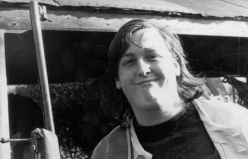
I joined Greater Manchester Police in October 1977, pretty much straight out of University. At the time I was about as unlikely a recruit as you could imagine. When I walked into the then GMP Headquarters on Southmill St I was wearing jeans and a grubby sweatshirt, had hair half-way down my back and almost certainly hadn't had a shower or a shave that morning (See top picture)!! It was a few months since I had graduated, time spent looking around for a career and finding nothing that appealed. A few days previously a friend I was playing pool with in the pub had laughingly suggested I should join the Police (ironic given that he was, as I found out later, a prolific burglar). I laughed it off at the time - the Police was something I had never once considered as a career - but the seed had been sown and a week later here I was. One of the pictures below is me, 27 years later, getting my Long Service and Good Conduct medal from the Chief Constable with my wife Naomi looking on.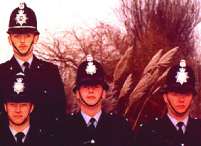 I had a four-hour long chat with a retired Chief Inspector and he pretty much sold me on the idea, and a week later I returned after a haircut and wearing a suit and signed on the dotted line. In 29½ years in the Police I have never regretted that decision for an instant. I did my initial training at Peterloo House and then at Bruche training centre in Padgate, Warrington (Passing Out picture on the left). When I joined I had to move out of the flat I had been sharing with a student friend in the depths of Whalley Range and moved into the Police single men's hostel at Bury and so it was fairly natural that it was to Bury Division that I was posted when my training finished.
 Bury 1978
) Bury is a nice place to live and it's perhaps not surprising that it is one of the quieter Divisions in GMP. I spent in total 5 years on the Division, initially as a foot patrol and later in a panda or the van. I also spent some time in Communications there as well as 6 months as a CID aide (during which I realised that the CID was probably not where I wanted to spend my career). My shift, "4 Scale", was a great bunch and we were a tight-knit team who worked hard as a team and also socialised together as a matter of course. Many's the time we'd head off to the pub after finishing an afternoon shift and then onto a nightclub later and finish off with a curry at the local indian restaurant in the early hours of the morning, even if we were due back on duty at 6am!
Bury is a nice place to live and it's perhaps not surprising that it is one of the quieter Divisions in GMP. I spent in total 5 years on the Division, initially as a foot patrol and later in a panda or the van. I also spent some time in Communications there as well as 6 months as a CID aide (during which I realised that the CID was probably not where I wanted to spend my career). My shift, "4 Scale", was a great bunch and we were a tight-knit team who worked hard as a team and also socialised together as a matter of course. Many's the time we'd head off to the pub after finishing an afternoon shift and then onto a nightclub later and finish off with a curry at the local indian restaurant in the early hours of the morning, even if we were due back on duty at 6am!) 1980 saw the Steel Strike and I ended up spending lots of time sat in Personnel Carriers in and around Sheffield. 1981, however, brought the riots in Toxteth, Salford and Moss Side. First thing we knew was being bundled into personnel carriers across to Toxteth and then standing for hours behind our shields (but with no proper helmets) with bricks, railings and other objects being chucked at us. End result, plenty of bobbies injured and hardly anyone arrested.
1980 saw the Steel Strike and I ended up spending lots of time sat in Personnel Carriers in and around Sheffield. 1981, however, brought the riots in Toxteth, Salford and Moss Side. First thing we knew was being bundled into personnel carriers across to Toxteth and then standing for hours behind our shields (but with no proper helmets) with bricks, railings and other objects being chucked at us. End result, plenty of bobbies injured and hardly anyone arrested.')) When Moss Side and Salford erupted our Chief Constable, James Anderton, adopted a somewhat more aggressive approach: Firstly he acquired decent riot helmets for us, and secondly we were allowed to try to break up groups of rioters and arrest them. End result: Lots of rioters arrested and not nearly so many bobbies injured.
When Moss Side and Salford erupted our Chief Constable, James Anderton, adopted a somewhat more aggressive approach: Firstly he acquired decent riot helmets for us, and secondly we were allowed to try to break up groups of rioters and arrest them. End result: Lots of rioters arrested and not nearly so many bobbies injured. Whilst at Bury, I also spent 6 months seconded to the central licensing squad, the Hush Puppies at they were then known. That was great fun albeit fairly hairy at times, working undercover in pubs, clubs and shabeens all over the force area, sometimes doing observations for other departments such as the Drug Squad. Most of the time these duties were fairly routine and mundane observations after tip-offs about under-age or after-time drinking. Sometimes, however, we would be asked to be inside premises prior to and during a Police raid (eg: for drugs) and at other times we'd be asked to carry out observations in situations that would be really quite dangerous if our identities were discovered. All in all, though, one of the best and most fulfilling periods of my career.
I'd passed my Sergeants exam in 1979 and in 1982 was posted to Salford as a result of a [failed] Promotion Board in which it was suggested that I should "...go and see the city lights". Bury was a pleasant town in which to live, but not hugely busy in Police terms. It had its moments, of course, but generally I was going to experience and learn a lot more, a lot quicker, on an inner-city division, so I looked forward to my time in Salford.
Salford 1982
) Salford was a bit of a culture shock in Police terms. I worked the Divisional Van at The Crescent for 2 years. Salford was much busier than Bury and I absolutely adored the time I spent at The Crescent. Although the 5 years I had spent at Bury had been interesting and I'd learned a lot, it was Salford that completed my Police education. The "South" Sub-Division, as The Crescent was known, was arguably the busiest part of Salford, then full of urban decay and destitution. What are now yuppy townhouses were then squalid flats and rows of terraced houses. Even in the midst of the worst of these areas, however, you would find a rose amongst the thorns. I remember at 2am one morning I'd parked my van up and was having a quiet walk around Regent Square, then one of the most deprived and destitute areas in Salford. I turned a corner and came across an 80-year old pensioner hard at work scrubbing her door-step and the pavement outside, having just repainted the ledge under her front window.
Salford was a bit of a culture shock in Police terms. I worked the Divisional Van at The Crescent for 2 years. Salford was much busier than Bury and I absolutely adored the time I spent at The Crescent. Although the 5 years I had spent at Bury had been interesting and I'd learned a lot, it was Salford that completed my Police education. The "South" Sub-Division, as The Crescent was known, was arguably the busiest part of Salford, then full of urban decay and destitution. What are now yuppy townhouses were then squalid flats and rows of terraced houses. Even in the midst of the worst of these areas, however, you would find a rose amongst the thorns. I remember at 2am one morning I'd parked my van up and was having a quiet walk around Regent Square, then one of the most deprived and destitute areas in Salford. I turned a corner and came across an 80-year old pensioner hard at work scrubbing her door-step and the pavement outside, having just repainted the ledge under her front window.I spent two years at The Crescent, crewing the double-manned Divisional Van for the most part, which was great fun because the Van wasn't the first port of call for the more mundane jobs that arose, but you could choose to attend any jobs where you felt some additional manpower would assist, and the Van was the default method of transporting prisoners, so we tended to get involved with the more serious matters.
In 1984 I went as an Acting Sergeant on the Eccles Sub-Division for 6 months, my first taste of supervising. That was followed by 6 months at the Swinton Sub-Division, back as a PC. Although not as busy as The Crescent, Eccles and Swinton were both good places to work with a mix of 'nice' and 'not-so-nice' areas.
In 1985 I went into the Divisional Communications at Salford for 15 months. This was a really busy Comms suite where the work was pretty stressful. Even then we never had enough resources outside to do the job and it was not unusual to have a list of 20 or 30 outstanding incidents waiting for an officer to attend them when we came on duty. Although stressful, I really enjoyed working in Comms. This was before the advent of computerised incident-handling and all of our records were on paper message-pads, which made keeping numerous different jobs, each with their own priority and requirements, uniquely challenging
In mid-1986 I went back outside to the Park Lane Subdivision (very similar to working at The Crescent) for 6 months and then at the beginning of 1987 I was promoted to Sergeant and posted to the City Centre, the A Division at Bootle St.
Bootle St 1987
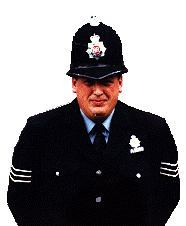 When I arrived at Bootle St I was put onto D Relief. I remember that 3 Sergeants arrived on D Relief on the same day so there were 3 of us finding our feet at the same time. We had a great crowd of officers to work with, though, led by the inestimable Bob Swan, an Inspector of the old school, but one who was not averse to having some fun while we were working. After learning my trade as a Sergeant for a while I was sent to work in the infamous CDC, the Central Detention Centre at the City Magistrates Court, and spent 6 months there as a Custody Officer. This was a somewhat depressing enviroment and was probably the only part of my entire Police career I would as soon as not repeat.
When I came out of the CDC it was straight into Communications at Bootle St, and I was there until 1991 helping to run one of the busiest Divisional Communications in the force at the time. I would happily have stayed there but was asked to help oversee the introduction of a force-wide Command & Control system in the early 90's and spent a while on that, cascade training all the staff on the Division in a system that remains central to our incident handling crime management and duty management to this day.
) While I was engaged on this I was sharing an office with the Roll Call and ended up writing 2 database systems for them as a favour. In due course the Roll Call Sergeant moved on and I was gently nudged into his place. By this time, though I was looking after almost everything to do with IT for the whole Division and was the Roll Call Sergeant up till 1997 when the post was civilianised. In the meantime I retained my interest in the Communications side of things as one of the Silver Control Sergeants for such incidents as the 1991 Bombing, Euro '96 and the 1996 Bombing, the World Triathlon Championships and later still the 2002 Commonwealth Games. During the course of that I redesigned the Silver Control twice till we had a room that was the envy of all and served as a template for future rooms up till the creation of the Control Room for the 2006 Labour Party Conference.
While I was engaged on this I was sharing an office with the Roll Call and ended up writing 2 database systems for them as a favour. In due course the Roll Call Sergeant moved on and I was gently nudged into his place. By this time, though I was looking after almost everything to do with IT for the whole Division and was the Roll Call Sergeant up till 1997 when the post was civilianised. In the meantime I retained my interest in the Communications side of things as one of the Silver Control Sergeants for such incidents as the 1991 Bombing, Euro '96 and the 1996 Bombing, the World Triathlon Championships and later still the 2002 Commonwealth Games. During the course of that I redesigned the Silver Control twice till we had a room that was the envy of all and served as a template for future rooms up till the creation of the Control Room for the 2006 Labour Party Conference.In 1997 the powers that be civilianised the role of Roll Call Sergeant and so I went back onto a shift, this time as a Custody officer and remained there until 2002. Custody Officer was one of the more responsible roles for Sergeant then as you were making all the decisions relating to the detention, charging, bailing and welfare of persons in custody. Things have changed since 2002 so now many of the decisions on charging are made by the Crown Prosecution Service rather than by the Police, but it has always been and will continue to be one of the more interesting and rewarding roles for Sergeants.
Headquarters 2002
) In 2002 I came off my Relief to set up the Silver Control communications for the 2002 Commonwealth Games in Manchester. This was a huge operation of which the communications was only one side, but setting up the databases for the resources and then helping to run one of the Silver Controls for the event was great fun and it was nice to contribute to something that came off to successfully. When the Games finished I was asked to go and assist with a computer project to replace GMP's Personnel, Duty Management, Training Administration and Health & Safety systems with a single integrated HR package that was being introduced in numerous forces around the UK as part of a national strategy. This was absolutely fascinating work involving formulating a lot of changes to force policy, working on the creation of support systems and databases that would facilitate the introduction of the new system and working with other forces and the software suppliers. I was particularly concerned with the Duty Management part of the system, which allowed me to combine my experience with databases, computing within the Police and Roll Call matters to help to bring that side of the project to a conclusion. In the end, technical problems with the system delayed its introduction and I had to leave the project before the Duty Management side was introduced.
In 2002 I came off my Relief to set up the Silver Control communications for the 2002 Commonwealth Games in Manchester. This was a huge operation of which the communications was only one side, but setting up the databases for the resources and then helping to run one of the Silver Controls for the event was great fun and it was nice to contribute to something that came off to successfully. When the Games finished I was asked to go and assist with a computer project to replace GMP's Personnel, Duty Management, Training Administration and Health & Safety systems with a single integrated HR package that was being introduced in numerous forces around the UK as part of a national strategy. This was absolutely fascinating work involving formulating a lot of changes to force policy, working on the creation of support systems and databases that would facilitate the introduction of the new system and working with other forces and the software suppliers. I was particularly concerned with the Duty Management part of the system, which allowed me to combine my experience with databases, computing within the Police and Roll Call matters to help to bring that side of the project to a conclusion. In the end, technical problems with the system delayed its introduction and I had to leave the project before the Duty Management side was introduced. In the spring of 2006 I moved back to Bootle Street, working on the Logistics Team for the Labour Party Conference in September 2006. As with the HR project, it was absolutely fascinating to be involved in the planning stage of such a large event. The Logistics side of this was pretty mind-boggling, with up to 1500 officers being involved on each day. They were to consume well over 20,000 meals over the period of the Conference, used several hundred vehicles, and some from outside forces, the Army and the Home Office etc required accommodation as well. The Logistics Team had to organise all this in advance, as well as providing up-to-the-minute figures for the Transport and Catering departments, Roll Calls and senior management. During the conference we were working 24/7 providing a point of contact for logistics-related problems and trouble-shooting where problems arose, as they inevitably did. All in all it was a really enjoyable and rewarding 6 months, not least creating a very complex database to handle the massive amount of data we had to generate and then keep up-to-date.
Stretford 2006
 my Long Service and Good Conduct Medal from the Chief Constable in 2005')) When the Labour Party Conference came to a very successful conclusion in October 2006 I was in a somewhat curious position of having 12 months to do till retirement but with no "home" to go back to. In the end I was transferred to the Trafford Division to work in the Custody Office again and I remained there till I retired in October 2007. Trafford Division stretched from Stretford all the way down to the Cheshire border. At Stretford, though, we were only 300 yards from Old Trafford football ground, and natch days were particularly busy for the Custody office. As mentioned above the role of Custody Officer had changed considerably since 2002 but it remained a rewarding and challenging one. The mechanics of the job have changed too, with Custody Records now created electronically on a database rather than being written out by hand. This was a long overdue change. Indeed I'd developed a custody office database for Bury Custody Office back in 1996 at the request of my mate Joe Vaiders because the force was so slow in coming up with a force-wide solution.
When the Labour Party Conference came to a very successful conclusion in October 2006 I was in a somewhat curious position of having 12 months to do till retirement but with no "home" to go back to. In the end I was transferred to the Trafford Division to work in the Custody Office again and I remained there till I retired in October 2007. Trafford Division stretched from Stretford all the way down to the Cheshire border. At Stretford, though, we were only 300 yards from Old Trafford football ground, and natch days were particularly busy for the Custody office. As mentioned above the role of Custody Officer had changed considerably since 2002 but it remained a rewarding and challenging one. The mechanics of the job have changed too, with Custody Records now created electronically on a database rather than being written out by hand. This was a long overdue change. Indeed I'd developed a custody office database for Bury Custody Office back in 1996 at the request of my mate Joe Vaiders because the force was so slow in coming up with a force-wide solution.
Retirement October 2007
On 10th October 2007 I retired from the Police. My original plan had been to continue to work for GMP, but Naomi's health had not been so good the last 18 months so that plan changed. I owe GMP a huge amount for the immensely rewarding and fulfilling career I've had. I wouldn't swap one minute of it and would happily do another 30 years, all things being equal, but most good things come to an end. I've made lots of really good friends over my years in GMP, and cherish my time there.Although I really loved Manchester and the North-west as a place to live and work, we moved to Scotland after I retired, to be nearer to Naomi's family. My days are filled with looking after Naomi, housework, gardening, picking up dog poo, programming and playing Bridge.
×
![]()